
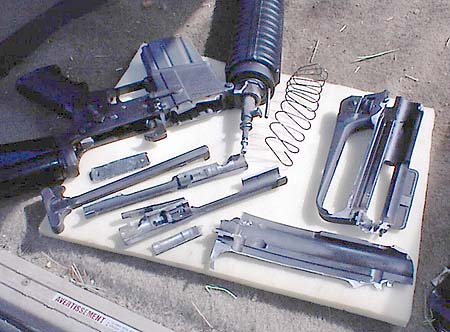
"Would not believe it if I hadn't seen it! We were shooting our monthly offhand, winter fun shoot, when I heard the line officer yelling "cease fire, cease fire". One of the shooters had a MAJOR malfunction!! When I approached, I found an AR with NO upper receiver, none! The bolt was stuck in the barrel extension like a spark plug.
When the carrier started moving rearward, the bolt, for some reason rotated only a few degrees and LOCKED UP! The carrier continued to the rear and was split down the middle by the cam pin, as though you were splitting a log. As the carrier split, it blew the upper into two large pieces and a few smaller ones. The left half of the upper flew about 15' grazing a fellow on the bridge of the nose causing a very minor cut. The right half flew about ten feet. The left half of the carrier followed the left half of the upper while the right half of the carrier moved to the rear far enough to lodge in the buffer tube about an inch. The guts of the mag were blown out the bottom, and the magwell of the Eagle Arms lower was bulged about 3/16ths" on each side. The shooter sustained NO injuries. The shooter is a seasoned highpower veteran, and experienced reloader.
When the bolt was finally removed from the barrel extension, it was found that the rear of the cartridge case had been crumpled and looked like a belted magnum. The extractor had been blown loose, with its front section bent back into the barrel extension. This is what stopped the rotation of the bolt. When the extractor blew, it took a piece of the base of the case with it, [or more likely, vice versa; Ed.] undoubtedly venting massive amounts of gas into the upper. I personally don't feel this alone would be enough to destroy an upper upper. It could certainly cause severe damage. It was the splitting of the carrier that amazed me. Last night I was talking to 6 or 8 guys who were there. A few of us noticed the same thing. When the carrier split, it exposed the grain of the metal. The area in front of the cam pin had a different look. We knew when the thing let go that a lot of gas was present in that area, but we did not feel the gas alone was responsible for the difference. A few of us are of the opinion that there may have been a small fracture in the carrier in front of the cam pin. This was about the first thing I noticed at the range that day. It had an oxidized look, something I didn't feel could occur in one quick instant.
Hmm... let's do a back-of-the envelope analysis. Let's say that 50,000 psi gas was vented into the carrier. The rear of the carrier has, oh, let's say for argument, 1 in2 of area. That's a 50,000 psi hammer on the carrier. The cam pin can't have an area more than, oh, ½ sq. in. That means that the cam pin and carrier had to withstand a 100,000 psi blow to them. Since the carrier is a very thin section (probably much less than ½ in2), I'm not surprised it yielded, as the yield strength of the steel used may have been in the 100-150K psi range. The curvature of the cam pin may have concentrated that 50,000 pound whack into a much smaller area than ½ in2, thus multiplying its effect to 150,000 or even 200,000 psi.
The magnitude of the forces involved in firearms goes well beyond our everyday experience. The violence that occurs in the chamber of a rifle is unnoticed until it leaks out in an unwanted way.
The splitting of the carrier as one splits a log is of no surprise to me whatsover.
As for the "oxidation," this could indeed occur in "one quick instant." The temperatures and pressures found in the unrestrained gas are again beyond our everyday experience. Not to say that there wasn't a crack there already, just that a detailed metallurgical analysis would be required to evaluate the possibility. In any case, there could well have been enough force acting to split the bolt carrier without the preexistence of a crack.
Dontcha love them reloads?
—Walt Kuleck